Choosing the right laminar flow hood requires more than comparing prices or selecting a model based on appearance. You need to evaluate technical specifications that directly affect airflow quality, filtration performance, workspace capacity, and daily laboratory operations. Whether you work in pharmaceutical research, electronics assembly, biotechnology, or sample preparation, the right equipment helps maintain a controlled, clean working environment. By comparing essential specifications before purchasing, you can identify a suitable laminar flow hood that meets your application requirements, supports consistent performance, and provides long-term value.
1. Compare Vertical and Horizontal Airflow Designs
Start by identifying the airflow configuration that suits your laboratory processes. Laminar flow hoods generally use vertical or horizontal airflow designs, and each offers different workspace advantages.
A vertical laminar flow hood directs filtered air downward toward the work surface. This arrangement can be suitable for applications where vertical airflow is preferred and workspace organization is important.
A horizontal laminar flow hood delivers filtered air from the rear toward the front opening. It can support applications such as optical assembly, electronics handling, and other processes involving exposed components.
Before purchasing, compare:
- Airflow direction and distribution.
- Workspace dimensions and accessibility.
- Equipment placement requirements.
- Sample handling procedures.
- Compatibility with your laboratory workflow.
Choose the configuration based on your actual process rather than assuming one design is universally better.
2. Evaluate HEPA Filter Efficiency
Filtration performance is one of the most important specifications to examine. Most conventional laminar flow hoods use HEPA filtration to remove airborne particulate contaminants from the supplied air.
When comparing models, check the following:
- HEPA filter efficiency and applicable test standard.
- Filter dimensions and construction.
- Filter replacement accessibility.
- Initial and final pressure drop specifications.
- Filter integrity testing and certification availability.
For example, a commonly specified HEPA filter captures 99.97% of particles at 0.3 microns under the applicable test conditions. However, you should verify the actual filter rating and supporting documentation for each model.
Do not evaluate filtration efficiency in isolation. Proper installation, sealing, airflow distribution, and maintenance also influence overall performance.
3. Compare Airflow Velocity and Uniformity
Airflow velocity determines how quickly filtered air moves through the working area. However, higher velocity does not automatically mean better performance.
Compare the manufacturer’s stated airflow velocity, measurement locations, acceptable variation, and test conditions. Ask whether the airflow has been tested across the usable work zone rather than at a single measurement point.
You should also consider:
- Airflow uniformity across the work surface.
- Potential turbulence around equipment.
- Recovery after routine workspace disturbances.
- Performance under normal operating conditions.
Consistent airflow helps create a predictable working environment. Request documented airflow test results instead of relying exclusively on advertised performance figures.
4. Check Working Area Dimensions
A laminar flow hood should provide enough usable space for your equipment, materials, and operating procedures.
Compare internal width, depth, and height rather than focusing only on external cabinet dimensions. Consider how much room your process requires when instruments, containers, and other materials are positioned inside the hood.
For accurate comparisons, evaluate:
- Usable work surface dimensions.
- Internal clearance and working height.
- Maximum equipment footprint.
- Front access and operator positioning.
- Available space for future workflow changes.
A compact benchtop model may suit laboratories with limited floor space, while a larger freestanding unit may accommodate more demanding workspace requirements.
5. Examine Construction Materials and Build Quality
Material selection affects durability, cleaning requirements, and compatibility with your laboratory environment.
Compare the materials used for the work surface, cabinet body, internal panels, and external housing. Stainless steel is commonly selected for its durability and ease of cleaning, while other materials may offer different cost or application benefits.
Check whether the construction provides:
- Smooth, accessible surfaces.
- Corrosion resistance where required.
- Strong cabinet joints and stable support.
- Easy-to-clean internal components.
- Compatibility with your cleaning procedures.
Select materials according to your operating environment, chemical exposure, and maintenance expectations.
6. Review Electrical Requirements and Operating Features
Electrical compatibility is essential for reliable equipment operation. Compare the voltage, frequency, power consumption, and plug configuration before selecting a model.
Also examine the available operating features, including:
- Adjustable blower speed.
- Built-in illumination.
- Airflow velocity monitoring.
- Filter pressure gauges.
- Electrical outlets.
- Optional stands and casters.
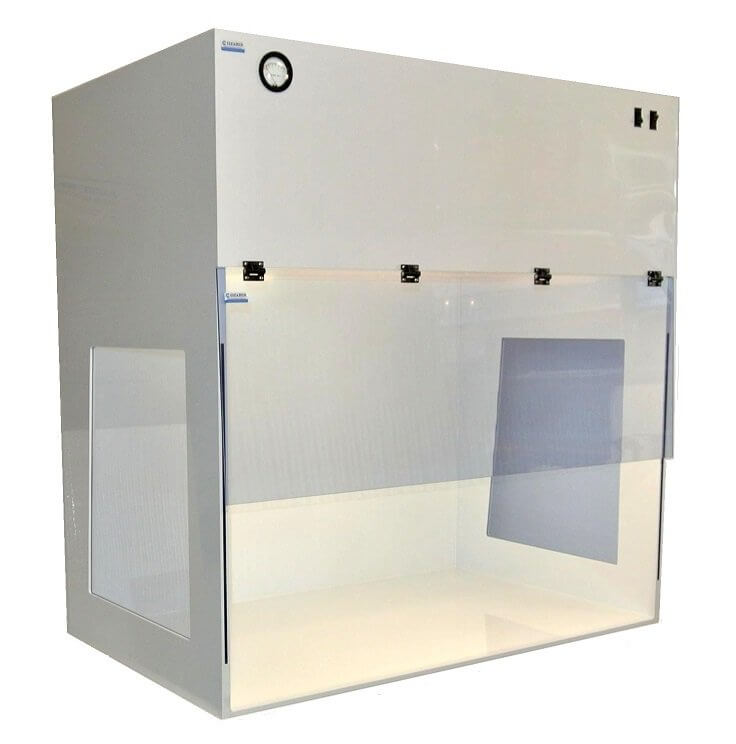
A filter pressure gauge can help you monitor filter loading and identify when maintenance or replacement may be necessary. Adjustable blower controls can also help you maintain appropriate operating conditions.
Make sure the equipment’s electrical requirements match your laboratory’s power supply.
7. Compare Noise Levels and Maintenance Requirements
Your laminar flow hood may operate for several hours every day. Therefore, noise levels, maintenance accessibility, and replacement costs deserve attention.
Ask manufacturers about operating sound levels, fan motor service requirements, pre-filter cleaning procedures, and HEPA or ULPA filter replacement intervals.
Compare the following:
- Noise output during normal operation.
- Accessibility of filter compartments.
- Availability of replacement filters.
- Ease of cleaning internal surfaces.
- Technical support and maintenance documentation.
Consider the total cost of ownership rather than focusing exclusively on the initial purchase price.
8. Evaluate Accessories and Customization Options
Additional features can improve workflow efficiency when they address specific laboratory requirements. Depending on your application, you may need a stainless steel work surface, static-dissipative PVC sash, additional electrical outlets, or a dedicated equipment stand.
Compare available accessories and determine whether they are included in the quoted price or offered separately.
Before you buy a laminar flow hood for laboratory clean-air applications, compare complete configurations, including accessories, installation requirements, filtration options, and technical specifications.
9. Compare Manufacturers and Technical Documentation
A reliable supplier should provide clear product specifications and support your equipment selection process. Review product datasheets, available filter documentation, warranty conditions, customization options, and technical assistance.
Explore the laboratory equipment solutions offered by CleaTech LLC to compare different laminar flow hood configurations, sizes, materials, and accessories.
Prepare a comparison sheet containing the model number, airflow direction, filter efficiency, working dimensions, airflow velocity, electrical requirements, construction material, and total price. This makes it easier to identify differences between competing models.
Conclusion
Comparing laminar flow hood specifications before buying helps you select equipment that matches your laboratory’s actual requirements. Focus on airflow configuration, HEPA filtration, airflow uniformity, workspace dimensions, construction materials, electrical compatibility, and maintenance costs. Remember that laminar flow hoods primarily protect products and samples, not operators from hazardous substances. Review technical documentation and confirm application suitability before placing an order. For assistance evaluating configurations and available options, Contact us today to discuss your laboratory equipment requirements.
Frequently Asked Questions
What specifications should you compare when buying a laminar flow hood?
Compare airflow direction, HEPA or ULPA filter efficiency, airflow velocity, working dimensions, construction materials, electrical requirements, noise levels, and maintenance accessibility.
What is the difference between vertical and horizontal laminar flow hoods?
Vertical models direct filtered air downward toward the work surface, while horizontal models move filtered air from the rear toward the front. Your application and equipment arrangement should determine the appropriate configuration.
Is HEPA or ULPA filtration better for a laminar flow hood?
HEPA filtration is suitable for many general clean-air applications. ULPA filtration provides higher particle-removal efficiency and may be appropriate when your process requires stricter particulate control. Select filtration based on documented performance requirements.
How do you determine the correct laminar flow hood size?
Measure your available installation space and calculate the working area required for instruments, samples, and materials. Compare internal workspace dimensions rather than relying only on external cabinet measurements.
Why should you compare maintenance requirements before purchasing?
Maintenance affects long-term operating costs and equipment performance. Reviewing filter replacement requirements, fan accessibility, cleaning procedures, and technical support helps you plan equipment ownership more effectively.